.png)
2026 International Chemistry Olympiad Competition
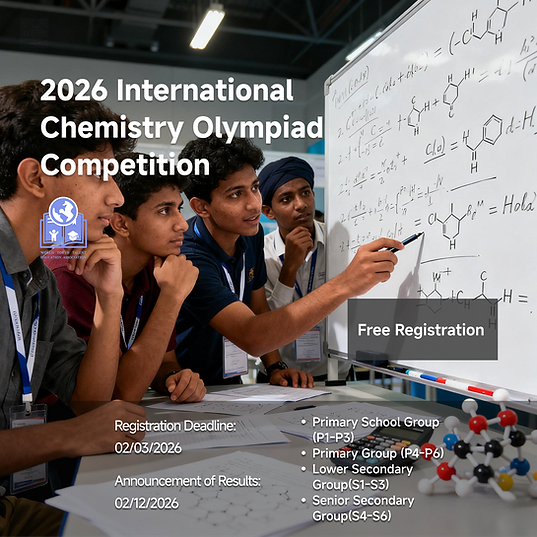
IMPORTANT TIMELINE:
Registration Deadline:03-02-2026
Announcement Date:12-02-2026
Registration Fee
Free
Nature of the Competition
Global Call
Age Categories
-
Primary School Group (P1-P3)
-
Primary Group (P4-P6)
-
Lower Secondary Group (S1-S3)
-
Senior Secondary Group (S4-S6)
Submission Format
-
Candidates, parents and teachers, this online examination will be conducted through a designated app. Parents or teachers will be required to assist in the operation according to the guidelines. Candidates will complete and submit the questions in the app and must strictly abide by the rules of the examination to ensure the smooth conduct of the examination.
-
The examination link will be sent during the examination period. The login information should be consistent with the information filled in during registration. The initial password will be sent via WhatsApp or email.
Awards
-
Champion — 90 points or above
-
Runner-up — 80 points or above
-
Third Place — 70 points or above
-
Excellence Award — Remaining scorers
Competition Awards for Mentors and Groups
⭐ Excellence Mentor Award
⭐ Outstanding Group Award
Competition Content
-
This online examination event is about to start. Please log in to the designated examination platform before the notified time and confirm that your personal information is correct. The examination link will be sent during the examination period. The login information should be consistent with the information you filled in during the registration. The initial password will be sent via WhatsApp or email.
Competition Rules
1、Originality: All entries must be completed independently by the participant. No submissions of others' works are allowed. Participants may use their own previous competition works.
2、Content Restrictions: All entries must not contain obscene, violent, sexual, defamatory, inappropriate, or controversial content. Violation of this rule will result in disqualification without prior notice.
3、Personal Data Use: Personal information provided by participants will only be used for competition contact purposes and to distribute competition notifications.
4、Accuracy of Information: Participants must ensure that their personal information is accurate. The organizers will not be responsible for any errors.
5、Acceptance of Terms: By submitting their entries, participants agree to all competition terms and conditions. The organizers reserve the right to disqualify any participant believed to have violated any competition rules, and there will be no appeals process.
Scoring Criteria
-
Knowledge Accuracy and Logical Coherence: When answering questions, accurately apply scientific knowledge points in the field of chemistry (such as the principles of chemical bond formation, chemical reaction mechanisms, and the corresponding laws of material structure and properties). The problem-solving ideas must be logically rigorous. Every step—from elaborating chemical theories, experimental operation norms, and data analysis methods to the entire reasoning process and final conclusion—must be closely linked, with no obvious knowledge errors or logical flaws. For discussion questions (e.g., discussing the impact of green chemistry technologies on industrial emission reduction) and analysis questions (e.g., analyzing the validity of chemical titration experimental data), there must be a precise understanding of scientific concepts such as "controlled experiments" and "chemical modeling". The argumentation process should be hierarchical and progressive, conforming to the systematic development logic of chemistry, to ensure the accuracy and coherence of the entire answering process.
-
Method Application and Skill Demonstration: Be able to skillfully apply appropriate chemical learning and analysis methods. For example, in experimental design questions, correctly use methods such as the controlled variable method and data induction method, just like accurately operating chemical laboratory instruments (e.g., burettes, volumetric flasks). In data analysis questions, use appropriate statistical tools and logical reasoning skills (such as concentration trend analysis, reaction rate correlation judgment). When dealing with interdisciplinary problems, skillfully integrate knowledge from multiple scientific fields (chemistry, physics, biology, etc.) for comprehensive analysis. The operation process should be smooth and natural, just like a professional chemist conducting research, demonstrating solid subject literacy and skill mastery, and making the problem-solving process efficient and accurate.
-
Answering Standards and Expression Presentation: Answers should be presented in a standardized manner. In formula derivation or experimental steps (if any), expressions must be accurate and in line with chemical scientific norms. The text should be concise, clear, professional and appropriate, complying with the question’s format and standard requirements. For example, in scientific essay questions, the structure should be clear with an introduction, body and conclusion. The language should be suitable for the theme and audience, avoiding overly obscure professional chemical terms that are not appropriate for young participants. When elaborating viewpoints, one can be as calm and rigorous as a scientific researcher presenting findings, communicating with examiners through precise language and typical chemical cases (such as major chemical technological innovations, classic chemical experiments like the Haber-Bosch process), showing good control over the answering process.
-
In-depth Understanding and Expansion Innovation: Have a deep understanding of the principles behind the chemical knowledge involved in the questions and their practical application scenarios. Not only can solve superficial problems (e.g., answering the definition of a chemical concept or the steps of a basic chemical experiment), but also expand answers in combination with real-world situations, putting forward innovative insights or solutions. For example, in questions about the development of green chemical materials, deeply explore multiple factors behind the phenomenon such as technological bottlenecks in catalyst development, policy support for low-carbon chemical industries, and environmental impacts of new material production, and propose unique ideas for promoting green chemical science and technology among global youth. Just like integrating cutting-edge chemical research into youth science education, it can resonate with examiners, demonstrating in-depth mastery and flexible application of chemical knowledge.
Group Registration Form
For groups of 4 or more members, please click the link below to access the group registration form. After filling it out, send it to us via WhatsApp or email.
For subsequent group entries, the group leader should name the works according to the competition requirements and submit all entries of the participants at once via WhatsApp or email.Entry Name: Name of Contestant - Age Group.【EG:Chan Ka Ming - Primary Group】
*If there are more than two participants, they need to fill in different mailboxes, otherwise the score cannot be counted.