.png)
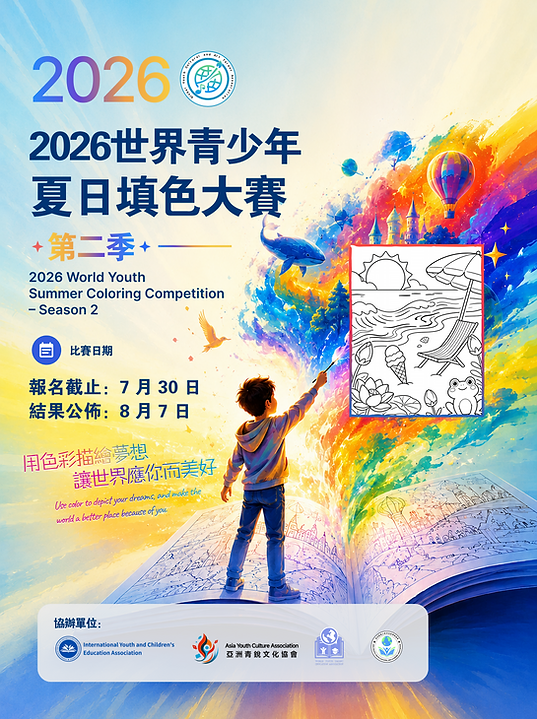
2026 World Youth Summer Coloring Competition【GYCATA ORGANIZE】
IMPORTANT TIMELINE:
Registration Deadline:2026-07-30
Submission Deadline:2026-07-31
Announcement Date:2026-08-07
Please complete the registration before uploading your work.
Registration Fee
Free
Nature of the Competition
Global Call
Age Categories
-
Kindergarten Group (K1 to K3)
-
Lower Primary Group (Grade 1 to Grade 3)
-
Higher Primary Group (Grade 4 to Grade 6)
-
Junior Secondary Group (Form 1 to Form 3)
-
Senior Secondary Group (Form 4 to Form 6)
-
Public Group (Post-secondary and above)
Awards
-
Super Gold Award (top 10% of participants)
-
Gold Award (11%-25% of participants)
-
Silver Award (26%-40% of participants)
-
Bronze Award (41%-60% of participants)
-
Excellence Award (61%-80% of participants)
Competition Awards for Mentors and Groups
Any school/education center/organization that nominates 10 or more participants will receive the "Institution Award" Trophy.
Any instructor who nominates 5 or more participants will receive the "Outstanding Instructor Award" Certificate.
Submission Specifications for Participants
-
Each participant is allowed to submit only one image of summer-themed coloring entry printed on A4 paper for creation. All entries must be created with the exclusive summer template of this competition, with no restrictions on coloring tools or painting styles.
-
Images of submitted coloring entries shall ensure complete shooting (the photograph shall clearly display template lines, coloring textures and additional hand-drawn details on blank areas; reflective glares, post-production filter color correction and cropping are not allowed; a full shot of the complete single artwork shall be submitted) and standardized formats (entries shall be in JPG/PNG format with a resolution of no less than 1080P, standard RGB color mode and a single file size not exceeding 20MB; images shall be free of platform watermarks and irrelevant stray objects in the frame, and truly restore the original painted colors and hand-drawn texture of the paper artwork), so that judges can conduct comprehensive and detailed evaluation of all details of the entries.
-
Participants of this competition shall only register and submit entry works via the Global Youth Cultural and Art Talent Association. Registration and work submission via third-party platforms or individual channels are not permitted. All participation qualifications and work collection shall be uniformly verified and managed by the Global Youth Cultural and Art Talent Association.
Competition Rules
1、Originality: All entries must be completed independently by the participant. No submissions of others' works are allowed. Participants may use their own previous competition works.
2、Content Restrictions: All entries must not contain obscene, violent, sexual, defamatory, inappropriate, or controversial content. Violation of this rule will result in disqualification without prior notice.
3、Personal Data Use: Personal information provided by participants will only be used for competition contact purposes and to distribute competition notifications.
4、Accuracy of Information: Participants must ensure that their personal information is accurate. The organizers will not be responsible for any errors.
5、Acceptance of Terms: By submitting their entries, participants agree to all competition terms and conditions. The organizers reserve the right to disqualify any participant believed to have violated any competition rules, and there will be no appeals process.
Scoring Criteria
-
Judges will evaluate and score participants based on their overall artwork, with scores ranging from 0 to 100 points.
-
These scoring criteria are designed to evaluate participants’ performance fairly and objectively. The specific details for each scoring category are as follows:
-
Creative Techniques (30%)
-
Technique Application and Precision
-
This assesses the participant’s ability to precisely master various coloring tools and techniques for summer-themed coloring art, including the evenness of the base color, the neatness of the edges where color meets the sketch lines, the integrity of the overall composition, the ability to render the texture of layered colors, the diversity of coloring techniques employed, the ability to add details to blank spaces, the control over the transition between the original sketch elements and added summer elements, the integration of summer mood with coloring techniques, and the balance of color rhythm throughout the artwork. For example, when creating works in a detailed style (such as coloring intricate floral patterns or depicting microscopic summer scenes) or works with a strong atmospheric feel (such as applying bold colors to intense evening sunsets or blending cool, light hues for a refreshing morning scene), the accuracy and flexibility in applying coloring techniques are crucial. This includes the ability to skillfully master the coloring logic of different tools—such as colored pencils, markers, and gouache, and whether these techniques blend naturally and harmoniously when combined. When creating color-filled works with different stylistic tones, the application of coloring techniques must accurately convey the essence of the summer theme, ensuring that the underlying sketch is fully preserved and the composition is richly layered; When handling compositions with multiple elements, participants must precisely control color transitions, visual depth, and the expression of summer emotions, demonstrating a unique charm in their coloring and precise control over the composition’s color, depth, and atmosphere.
-
Overall Harmony and Artistic Balance
-
This assesses the contestant’s understanding of and ability to interpret the principles of overall harmony and artistic balance in coloring works. Demonstrate the ability to precisely apply creative control techniques (such as variations in color depth, transitions between cool and warm summer tones, seamless integration of the original artwork with added elements, and the layering of textural quality in coloring) and coordination methods (such as the compatibility of summer color schemes, the consistency and stability of the visual style, the layered progression of atmosphere and emotion, and the alignment of coloring techniques with the essence of the summer theme) based on the summer theme and the requirements for emotional expression. For example, when creating elegant, still summer coloring pieces, use soft, layered coloring as a foundation and a balanced composition; when depicting lively and cheerful summer coloring pieces, create a childlike atmosphere through saturated, vibrant color schemes and flexible hand-drawn additions. Additionally, when adding original summer elements, ensure that the color scheme between the original template and the hand-drawn elements is consistent and blends naturally. The work should maintain a unified thematic style while showcasing personal flair, demonstrating a keen sense of and excellent control over the overall harmony and artistic balance of the summer coloring piece.
-
Interpretation and Style (25%)
-
Style Originality
-
The evaluation assesses whether a contestant’s summer coloring style possesses a distinct personal character. While preserving the integrity of the Association’s official template lines and maintaining the original structure of the template, contestants must incorporate their own unique color logic and creative summer-themed additions to stand out among the competition. For example, some participants may blend diverse visual styles to create a coloring style that aligns with the midsummer theme while retaining a personal flair; or they may develop a distinctive personal artistic language through color selection and the addition of shapes to blank spaces, imbuing their work with a distinct personal imprint and showcasing a unique aesthetic perspective on summer.
-
Innovative Interpretation
-
This criterion evaluates the originality of summer-themed coloring works in terms of thematic interpretation—such as innovative atmosphere, expressive forms, content integration, and the fusion of diverse imagery—to determine whether the work demonstrates ingenuity that enhances its visual uniqueness and artistic impact, thereby highlighting the contestant’s innovative thinking in aesthetic education.
-
Thematic Alignment and Emotional Atmosphere (20%)
-
Thematic Alignment
-
This evaluates whether the color palette, added details, and overall artistic conception of the coloring artwork closely align with the competition’s official theme. For example, an entrant might select standard summer creative elements—such as sunlight, fields of flowers, azure seas, evening breezes, and the chirping of cicadas—and pair them with a color scheme that captures the midsummer atmosphere. By building upon the Association’s exclusive template, the entrant can ensure that the color palette, added details, and overall mood of the artwork fully resonate with the official summer theme.
-
Emotional Expression
-
This category assesses whether participants can integrate their personal perceptions and emotions about summer into their artwork by comprehensively applying coloring techniques, color schemes, and creative additions to the blank spaces, thereby creating a unique artistic atmosphere that captures the essence of summer. For example, bright, high-saturation hues combined with rich, whimsical additions can express the joyful and carefree vitality of midsummer; while low-saturation, soft tones paired with simple, delicate additions can convey the tranquil and soothing atmosphere of a summer night. This allows the judges to experience summer emotions such as joy, coolness, tenderness, and warmth through the colored artwork, and to deeply appreciate the inner essence of midsummer captured in the piece.
-
Creative Difficulty and Artistic Impact (25%)
-
Demonstration of Difficulty
-
Evaluation focuses on the technical difficulty, color scheme complexity, and depth of composition in the contestant’s coloring of the official reference artwork. For example, works that involve highly advanced coloring techniques, meticulously planned additions, or the creation of distinctive summer scenes with a strong stylistic theme and rich visual layers require solid hand-coloring skills and a foundation in art education and aesthetics; At the same time, participants must strictly adhere to the rules, refrain from altering the original lines of the official template, and complete the creative enhancement within the constraints of the template framework, demonstrating their ability to master color, coordinate elements, and create atmosphere within a limited creative space.
-
Artistic Impact
-
The evaluation assesses whether participants can convey the emotions of summer through their finished works—which involve coloring the reference artwork and adding original details—to evoke a visual resonance with the judges. The works should allow the judges to sense the creator’s perception of summer and creative approach, while demonstrating a deep understanding of the official midsummer theme in their presentation. Through clean and cohesive coloring, a harmonious and unified visual atmosphere, and ingenious use of white space, the artwork breathes new summer vitality into the template. The visual presentation should be natural and comfortable, with a rich atmosphere that draws judges into the midsummer scene created by the work, allowing them to experience the unique summer innocence and artistic sensibility of youth.
-
During the scoring process, each contestant’s colored artwork will be independently evaluated by at least two judges to ensure consistency and fairness. The judging panel consists of artists with deep professional backgrounds in fine arts, as well as representatives from the arts education and cultural sectors; their expert evaluations will serve as a key basis for the competition results.